Small Vineyard
Can a small vineyard produce a real owner paycheck after labor, capital, and inventory costs?
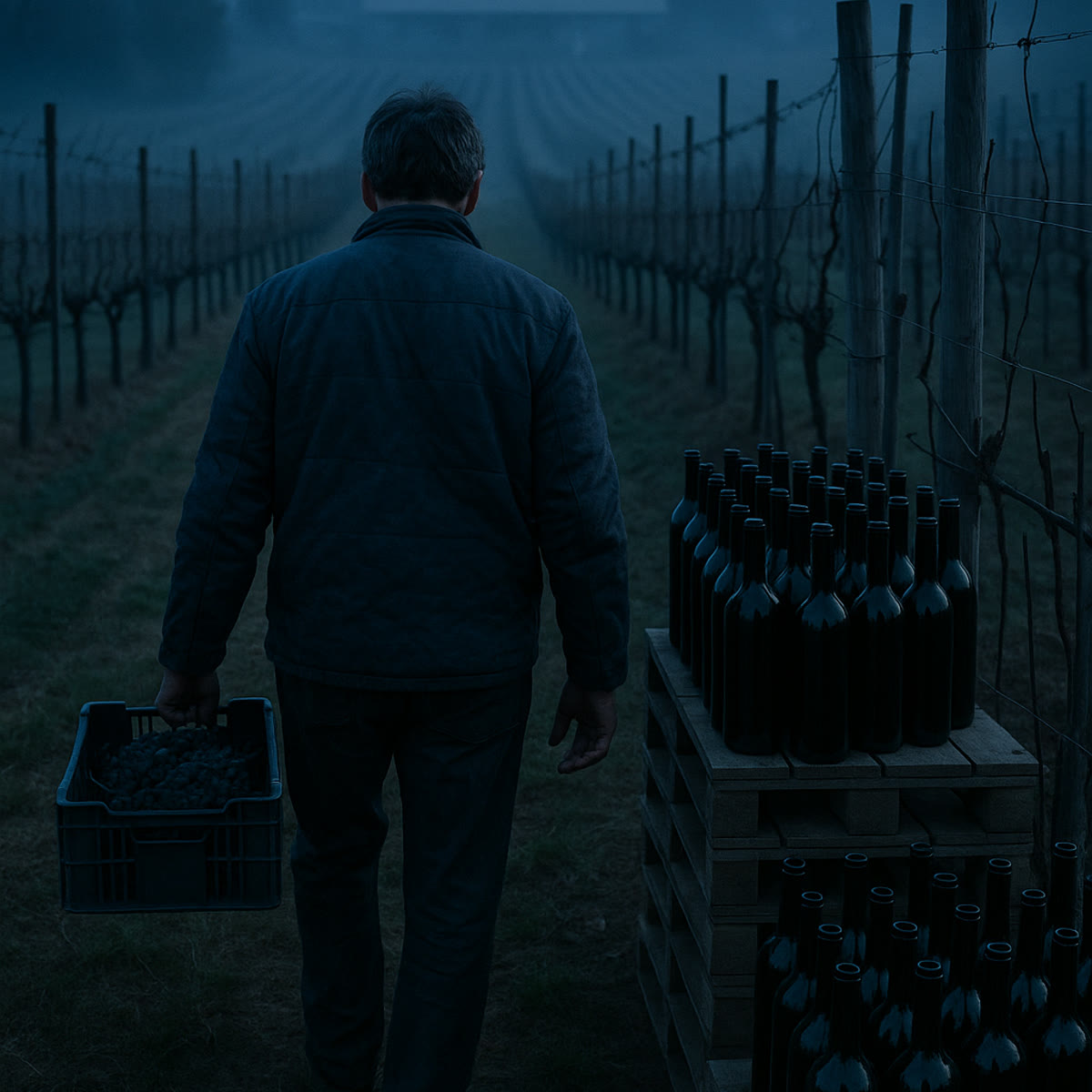
Can customers buy enough wine, often enough, to fund the owner before the vineyard accumulates unsold inventory?
The trap is mistaking positive modeled economics for cash available to pay the owner.
He tests repeat local buyers, customer acquisition, and a destination brand before withdrawing the expansion pitch in favor of a licensed pilot.
She separates contribution, economic profit, and cash flow, challenging both the half-hectare hobby and the larger vineyard’s ability to fund owner labor.
He favors contract production, shared services, and modest technology over owning equipment or acreage before demand, legal permissions, and operating quotes are proven.
The math that has to work
SARAH'S BACK-OF-NAPKIN14,000 sold bottles is the modeled economic break-even—but the five-hectare case still ends at -$13,500 cash after owner pay.
The modeled $12,000 economic result treats recoverable inventory as an asset, not cash available for the owner.
This week on Tri Diligence, the hosts investigate the gap between an appealing vineyard lifestyle and a business that pays for labor, capital, and inventory. The debate compares a learning plot, a half-hectare operation, and a roughly five-hectare vineyard. The key question is not simply how much wine the land can produce, but how much customers will buy, what selling it costs, and how much cash remains after the unsold bottles are paid for.
- Jake (the marketer) starts with a local wine brand and repeat buyers, pushes for an estate destination, then withdraws the expansion pitch when challenged on demand. His verdict is WAIT: prove legally permitted customer commitments and repeat buying before planting.
- Sarah (the investor) separates contribution, economic profit, and cash flow. Her verdict is PASS on an owned winery and WAIT on a pilot until supplier quotes, owner wages, inventory funding, and crop-loss resilience support the case.
- Ryan (the technologist) favors shared services and contract production over equipment ownership. His verdict is INVEST in a bounded, licensed pilot—not acreage, conditional on production quotes, legal review, and measured demand and labor.
### The numerical examples, without the audio arithmetic All figures below are illustrative modeling assumptions in USD—not current supplier quotes, forecasts, or a guarantee of vineyard performance. The geographic starting point is Virginia; costs, yields, licensing, and climate risks must be checked locally. Bottle counts are rounded scenario inputs. The model assumes $28 retail, $18 realized after modeled channel/selling deductions, and $8 variable cost per sold bottle: $5 production cost incurred on every bottle produced, plus $3 triggered by a sale. This yields $10 contribution per sold bottle. Vineyard operating costs are separate; actual fees, taxes, fulfillment, shipping and acquisition costs must be reconciled once, without double counting.
| Illustrative mature-year item | Half hectare | Roughly five hectares | |---|---:|---:| | Bottles produced | 2,500 | 25,300 | | Bottles sold | 1,500 | 15,200 | | Newly accumulated unsold bottles | 1,000 | 10,100 | | Contribution on sold bottles | $15,000 | $152,000 | | Fixed operating costs, including modeled rent | $8,000 | $45,000 | | Cash spent on newly accumulated inventory | $5,000 | $50,500 | | Operating cash before modeled owner compensation | $2,000 | $56,500 | | Owner labor valued at $35/hour | $14,000 / 400 hours | $70,000 / 2,000 hours | | Cash after modeled owner compensation | −$12,000 | −$13,500 | | Annual capital-recovery allowance | $4,000 | $25,000 | | Modeled economic result after labor and capital recovery | −$11,000 | +$12,000 |
The economic result assumes recoverable inventory remains an asset. It is not cash available to pay the owner. The larger example can show a positive modeled economic result while failing to fund the full owner paycheck in the current year. Storage, financing, spoilage, unsellable stock, additional selling costs, debt service, and taxes may worsen the cash position. Newly accumulating unsold vintages cannot be treated as a sustainable steady state. Capital recovery is an economic allowance, not an additional current-year cash payment in the cash rows above; initial establishment funding is separate.
The larger model's 14,000 sold-bottle economic break-even comes from $45,000 fixed costs + $70,000 owner labor + $25,000 capital recovery, divided by $10 contribution. It is not cash break-even when inventory is increasing, and acreage estimates hold overhead constant. The episode also tests a grape-only model, wholesale versus direct receipts, lower yields, and crop loss—each of which can change the answer sharply.
### What to prove before planting Obtain complete contract-production quotes, including minimum lots, bottling, storage, inventory ownership and payment timing. Validate site suitability, legal permissions and realistic seasonal labor. Test permitted local tastings, partner channels, purchase conversion and repeat orders rather than treating an audience target as secured demand. In the episode, the final pilot recommendation does not specify a dollar cap or a repeat-purchase measurement window: these remain diligence requirements, not settled operating criteria. The spoken $30 acquisition-cost target is an unvalidated test assumption, not an established profitable channel.
The technology discussion covers farm records, weather sensors, customer software, and AI-assisted notes or retention—not autonomous agronomic or pesticide decisions. Federal and state alcohol obligations, shipping permissions, zoning, insurance and production contracts require qualified review; a home-production exemption does not authorize commercial sales.
Bottom line: two rows can teach, but neither half a hectare nor a larger planting automatically creates a paycheck. Prove customers and fund the inventory before expanding the vineyard.
Transcript
Welcome to Try Diligence. I'm Jake, the marketer. Today, can a small Virginia vineyard pay a real salary, or does it just produce extremely expensive weekend plans?
I'm Sarah, the investor. We're separating three businesses. Growing grapes, selling a wine brand, and owning a winery. Buying vines doesn't automatically buy customers.
I'm Ryan, the builder. I support outsourcing fermentation before buying stainless steel. Tanks are terrible at admitting you have no sales.
But there's something here. Local adults buying a distinctive wine, returning for seasonal releases, joining a club. Not another anonymous bottle competing on a supermarket shelf.
Possible, not proven. Vintner Report puts American direct wine shipments at three point nine four billion dollars in twenty twenty-four, down five percent. We're entering a crowded market without a growth escalator.
Our beachhead is nearby repeat buyers, not all American wine drinkers. Established Virginia wineries like Early Mountain already compete for those visits and club budgets.
And grape customers are different. They're licensed wineries buying specific varieties, quality and harvest timing. They don't pay extra because your dog appears on the label.
He photographs beautifully, though.
Let's anchor the spreadsheet. Virginia Wine Board's twenty twenty-four report shows roughly two tons per acre. Our three-ton base case is an assumption, not the regional average.
Using American short tons throughout. Assume one hundred fifty gallons per ton, then ten percent cellar loss. That's about six hundred eighty-one saleable bottles per ton. Don't subtract losses twice from a supplier's yield estimate.
Start tiny. Two rows, each fifty meters long, vines one meter apart. About one hundred vines. Surely enough for a boutique launch?
Enough for learning. Row spacing and turning headlands determine the actual footprint. The brief estimates seventy to one hundred sixty bottles, not an automatically licensed micro-winery.
Illustratively, four thousand dollars to establish it, six hundred annually, and forty owner hours. At thirty-five dollars an hour, that's fourteen hundred dollars of labor before capital recovery. Hobby.
An educational hobby. The dog gets demoted to intern.
And those costs won't scale neatly. Shared tools or hired spraying beat owning machinery at that size. A contractor's minimum callout can dominate your budget.
Half a hectare is approximately one point two four acres. Three tons per acre produces about twenty-five hundred bottles. Sixty percent sell-through means fifteen hundred sold, not twenty-five hundred paid invoices.
Five hundred customers buying three bottles annually. That's a comprehensible local audience.
Comprehensible isn't profitable. Assume twenty-eight dollars retail, eighteen dollars realized after channel and selling deductions, then eight dollars production, packaging and fulfillment. Ten dollars contribution per sold bottle.
Split that eight-dollar allowance into five spent producing each bottle, sold or stored, and three triggered by sale. These are assumptions, not quotes. Reconcile taxes, shipping, fees and acquisition without double counting. Consumer sales tax isn't revenue.
For this half-hectare illustration, assume thirty thousand dollars establishment and eight thousand annual fixed operating costs, including modeled land rent. Fifteen thousand contribution leaves seven thousand before owner pay and the inventory increase.
Seasonal side income, then?
Not yet. A thousand unsold bottles consume another five thousand dollars. Operating cash before owner pay is only two thousand. Four hundred hours at thirty-five dollars leaves a twelve-thousand-dollar cash shortfall.
The modeled economic loss is eleven thousand after owner labor and four thousand capital recovery, treating recoverable inventory as an asset. That's different from cash flow. Unsellable stock needs a write-down, making the loss worse.
Then plant five hectares, about twelve point three six acres. Enough volume to carry the overhead. Build a destination.
That's your answer to weak demand? Manufacture more inventory?
No, build something customers can visit. Estate credibility supports premium pricing.
Or sign a hospitality partnership and buy grapes. You can test the wine and story without waiting years for roots. Disclose sourced fruit honestly.
Customers might prefer estate-grown.
Then make them prove it with purchases. I'm not funding a planting because customers hypothetically admire agriculture.
Fine. I withdraw the destination build. Licensed custom-crush pilot first, sold through permitted local partners and our own compliant channels. Planting becomes conditional on repeat demand.
Now the larger model. About twenty-five thousand three hundred bottles produced, fifteen thousand two hundred sold. At ten dollars contribution, that's one hundred fifty-two thousand dollars.
Assume forty-five thousand dollars fixed cash costs, including vineyard operations, rent, insurance and administration. Eight dollars variable excludes those vineyard costs, so we're not charging fruit twice.
Contribution less fixed costs is one hundred seven thousand dollars, not cash surplus. New inventory consumes fifty thousand five hundred. Operating cash is fifty-six thousand five hundred before owner pay, or negative thirteen thousand five hundred after.
So it doesn't fund the full paycheck. Replacement wheelbarrow money will have to wait.
The modeled economic result is still twelve thousand after seventy thousand owner labor and twenty-five thousand capital recovery, assuming recoverable inventory. Not available cash. Two thousand owner hours must also cover field work, selling and compliance.
Economic break-even is fourteen thousand sold bottles, not cash break-even with growing inventory. At sixty percent sell-through and two to four tons per acre, roughly nine to seventeen acres, holding overhead constant. Ongoing unsold vintages undermine that model.
How many humans is that?
For fifteen thousand two hundred bottles, perhaps five hundred club members buying twelve annually, plus twenty-three hundred other buyers averaging four. No double counting. Prove that audience exists locally.
Use partner tastings, email and referrals. Charge events separately and measure their contribution. Don't hide wine losses behind unpaid weekends pouring samples.
I'd test acquisition at thirty dollars per new buyer. Three bottles generate thirty dollars contribution before acquisition, so the first order barely pays back. Retention is the business.
And price matters. Holding deductions constant, twenty-dollar retail leaves roughly two dollars contribution; thirty-six dollars leaves eighteen. Wholesale at an assumed twelve dollars net leaves four. Fourteen thousand economic break-even bottles becomes thirty-five thousand, before extra channel costs.
That's beyond this planting's base production. More acres won't fix nonpositive contribution, either. Get actual distributor terms before mistaking shelf price for your receipts.
What if we skip bottles and sell grapes?
Assume eighteen hundred dollars per ton, explicitly not a current quote. Three tons yields fifty-four hundred dollars per acre. Against thirty-five hundred cash costs, nineteen hundred remains before central overhead, owner pay and capital.
With seventy thousand dollars of those remaining annual charges, break-even is about thirty-seven acres. Four-ton yields bring that near nineteen acres; two tons barely cover field costs. Twelve acres won't replace a full-time salary.
Site selection comes first. In humid Virginia, drainage, frost exposure and disease management drive labor. Dry-region irrigation and smoke risks are different budgets, not interchangeable national averages.
Walk me through the calendar before I accidentally promise September delivery.
Prune and train, manage canopy and pests, protect against birds, then harvest and transport quickly. Contract fermentation, maturation and bottling follow. Assume small crops around year three, maturity around year five, with release later depending on wine style.
For twelve acres, assume two hundred fifty thousand dollars establishment and total pre-revenue funding of four hundred thousand to five hundred thousand, including operating losses and inventory. Quote everything. Mature-year profit isn't cumulative payback.
Negotiate minimum lots, storage, quality sampling, harvest slots, packaging, title and insurance. TTB distinguishes custom-crush clients from bonded producers. Virginia alcohol licensing, zoning, wastewater and destination shipping permissions need separate review.
Owning equipment wins only when documented utilization savings exceed staffing, maintenance and capital costs. Land purchase adds financing needs too. Replace modeled rent with actual ownership costs; don't stack depreciation and principal repayments as identical expenses.
Technology stays modest. Farm records, weather sensors and customer software first. Artificial intelligence can summarize scouting notes and flag reorder opportunities, with expert review. It can't guarantee frost protection or prescribe pesticides autonomously.
And against us?
A funded competitor can use artificial intelligence for cheaper creative, personalized offers and retention. Generic local storytelling gets commoditized. Defensibility is trusted relationships, consistent wine and permissioned customer history.
Risk round. Half the crop leaves roughly seventy-six hundred bottles sold at our assumed sell-through. Contribution falls below fixed costs plus owner wages, even before capital recovery. A missed vintage is worse.
Using our rounded base-case counts, ten thousand one hundred bottles remain unsold. At five dollars production cash each, that's fifty thousand five hundred tied up, already deducted in our cash calculation. Storage, financing or write-downs could worsen it.
My verdict is WAIT. Next step, secure five hundred legally permitted, deposit-backed customers for fifteen hundred annual bottles. Above forty percent repeat purchase would unlock my planting discussion.
PASS on an owned winery, WAIT on the pilot. My next step is a quoted model with positive economics after thirty-five-dollar owner hours and enough cash for inventory, owner pay and crop loss. That evidence could change my vote.
INVEST in a capped licensed pilot, not acreage. Next step, obtain three production quotes and complete site and legal reviews before ordering vines. Measured demand and labor decide expansion. That's Try Diligence. Grow customers before vineyards.
Grow customers before vineyards: prove repeat demand and fund inventory before expanding acreage.