Roadside Reach
Can roadside advertising trailers become a real business, or are they just regulated billboards on wheels?
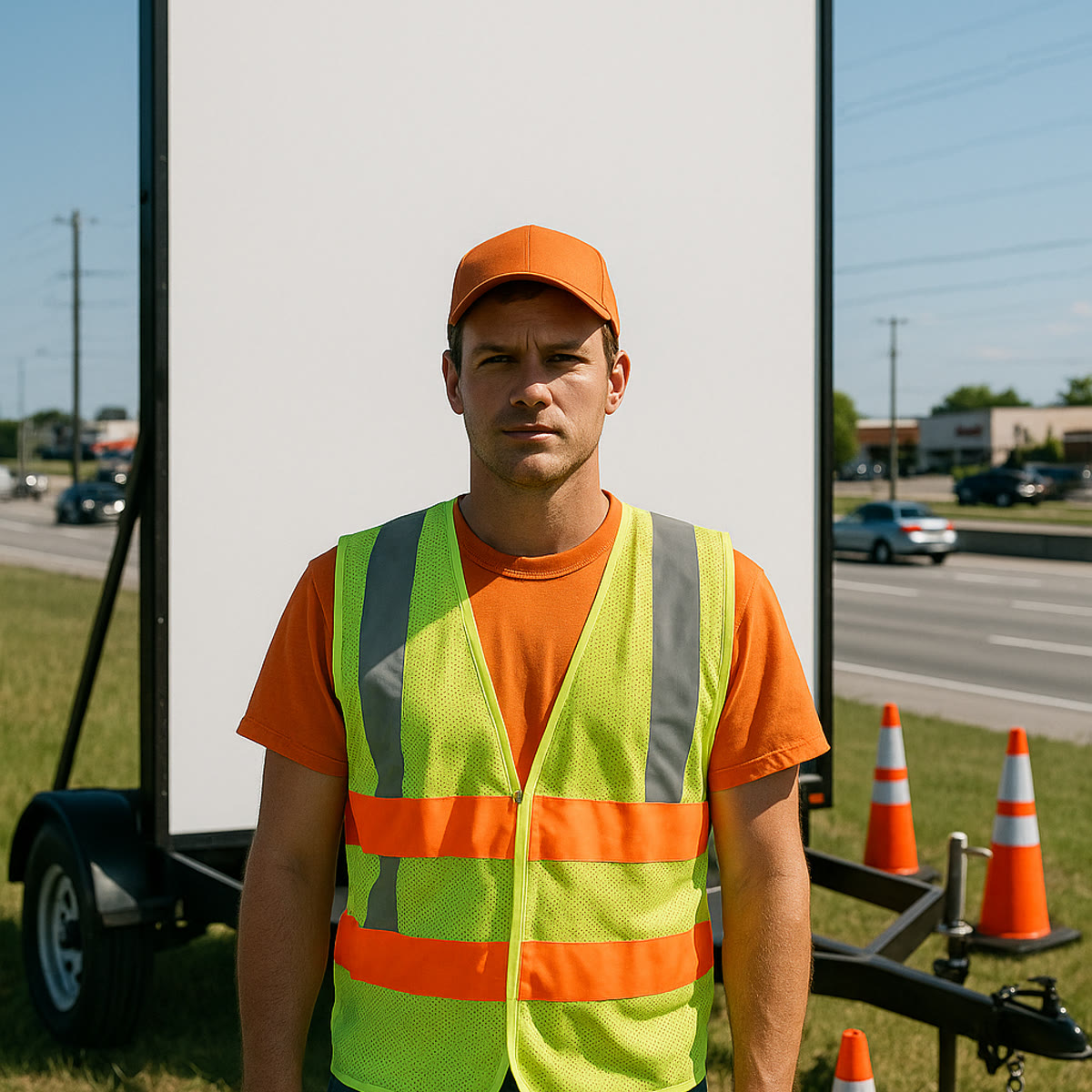
Does mobility create a better local ad product, or does it just add towing, permitting, and compliance risk to a billboard-like asset?
If the site can't clear legal review and earn recurring occupancy, the trailer becomes an expensive way to discover that visibility is not the same as value.
Tests whether local advertisers will pay for route-specific reach, simple creative, and proof that a roadside campaign actually drives response.
Pressure-tests site economics, land cost, occupancy, and whether the model can survive before overhead, depreciation, and vacancy eat the margin.
Focuses on permitting, safety, measurement, and whether the format is even legal before anyone spends on hardware or software.
The math that has to work
SARAH'S BACK-OF-NAPKINA weak site at $1,200 monthly revenue and 50% occupancy goes negative before trailer depreciation. A better site at $2,400 monthly price and 85% occupancy leaves only about $740 a month before central overhead.
That margin can work only if occupancy stays high and land, sales, servicing, and compliance costs stay tightly controlled.
This week on Tri Diligence: Roadside Reach, a US-focused network of stationary advertising trailers on private sites beside high-traffic roads.
The core fight is whether mobility creates a better advertising product or merely disguises a regulated sign. A promising location has to be legal, safe, visible, measurable, affordable to lease, and attractive enough that advertisers renew. If any one of those conditions fails, the trailer is easy to tow away — but the sunk sales, permitting, graphics, and setup costs remain.
- Jake (the marketer) asks which local advertisers could value route-specific reach and what proof would make a roadside campaign credible rather than cheap visual clutter.
- Sarah (the backer) tests site-level economics after land rent, permits, printing, insurance, sales commissions, inspections, maintenance, weather damage, and vacant months.
- Ryan (the technologist) examines parcel screening, audience measurement, creative testing, inspection systems, and how established digital out-of-home networks could use better data and AI to erase the newcomer's advantage.
The hosts compare the model with conventional billboards, mobile advertising, and local digital campaigns; examine why landowner permission alone may not be enough; and design a one-site pilot that requires written regulatory guidance and a pre-sold advertiser before a display is built.
Transcript
Welcome to Try Diligence, where three hosts put one business idea under three different microscopes. I'm Jake, the marketer. With me are Sarah, who audits my optimism, and Ryan, who turns ambitious nouns into expensive software.
Sometimes inexpensive software. The ambitious nouns remain a problem.
And I'm the investor asking when the nouns produce cash. Today, Roadside Reach leases private land beside busy roads, parks purpose-built advertising trailers there, and sells recurring campaigns.
I like it. Local businesses need geographic attention, conventional billboards can be scarce or intimidating, and this promises a simpler route package. Imagine three displays guiding commuters toward a new restaurant, each with one message and one memorable exit.
I like the demand, not the loophole story. Wheels don't sprinkle legal fairy dust on a billboard.
Correct. The Federal Highway Administration explicitly includes permanent or portable signs in its outdoor advertising framework. Under the Highway Beautification Act, states must control signs visible from Interstate and other covered highways. Then counties and cities add zoning, setbacks, spacing, safety, and permit rules.
Which means the product isn't sneaky trailers. It's compliant, measurable local outdoor advertising with movable hardware.
Mobility helps only after removal costs, towing access, anchoring, and the next approved site are considered. Moving an illegal trailer from one disappointed landlord to another isn't scalability. It's cardio.
Let's narrow the customer. I'd start with businesses where passing the location matters directly: restaurants, home services, auto dealers, attractions, healthcare clinics, real-estate developments, and events.
Good. The United States spent nine point one billion dollars on out-of-home advertising in twenty twenty-four, according to the Out of Home Advertising Association of America. But internet advertising took two hundred fifty-eight point six billion dollars. The real competitor is often a local owner's search and social budget.
And the segment should be narrower still. Find advertisers whose customers repeatedly drive one corridor and whose sale is valuable enough to measure. A roofing lead can justify far more spend than one discounted sandwich.
Although the sandwich has better creative.
You can't depreciate hunger, Jake.
The value proposition is affordable local reach, fast creative changes, and route-level targeting without buying a giant metropolitan campaign. The differentiator should be proof: dated installation photos, verified traffic counts, visibility audits, and maintenance records.
Traffic count alone is weak evidence. Direction of travel, speed, viewing angle, obstruction, readable area, and dwell time matter. Fifty thousand vehicles seeing the back of a trailer aren't fifty thousand impressions. They're fifty thousand tiny acts of confusion.
Price against realistic alternatives. Conventional static inventory might range from roughly two hundred fifty dollars to above fifty thousand dollars monthly, with perhaps two thousand five hundred to four thousand dollars per four-week cycle as a broad baseline. This product can't claim premium billboard pricing merely because traffic looks impressive.
For launch, I'd sell a good suburban arterial site at perhaps two thousand dollars monthly, plus six hundred dollars for adapted creative, printing, and installation. A three-site route package could be five thousand dollars monthly with a three-month minimum.
Now make the site earn that price.
Start static. No digital screens, illumination, or mobile routes. Those change power, maintenance, distraction, and permitting requirements. The first trailer needs engineered anchoring, documented wind-load tolerance, safe service access, tamper-resistant panels, and inspection after severe weather.
Channels should begin with direct outbound sales, local agencies, chambers of commerce, commercial brokers, and referral partnerships with printers. I'd prospect by corridor, not by industry, because density makes one salesperson's Tuesday survivable.
Lamar reports that seventy-nine percent of outdoor net revenue is local advertising. That supports the customer thesis, but Lamar also has around one hundred fifty-nine thousand displays. Roadside Reach begins with no brand, no audience data, and one trailer behind a suspicious garden center.
Then recruit one corridor champion. Give the first advertiser category exclusivity, a clean case study, and a referral credit. If the campaign produces trackable calls, neighboring businesses become prospects rather than cold names.
Use a memorable phone number, vanity web address, or offer code, but don't pretend every response is attributable. People may see the display repeatedly and search later. Brand-lift surveys become useful only once the network has enough scale.
Customer relationships need contracts long enough to cover selling effort. I want three to six months, prepaid monthly, with creative replacement charged separately. Events can buy shorter campaigns at a premium.
And rotate creative every sixty to ninety days, similar to established outdoor operators. Freshness gives us a retention conversation before the client quietly disappears.
Let's model one weak site. Assume one thousand two hundred dollars monthly revenue at fifty percent occupancy. That averages six hundred dollars. If land rent is four hundred, insurance and permits allocate one hundred fifty, maintenance and inspections cost one hundred, and sales commission is fifteen percent, contribution is already negative before trailer depreciation.
Plus transport, printing, installation, and removal. A fabricated static structure might cost, say, twelve thousand dollars, while setup and first graphics add three thousand. Those are assumptions, but the metal isn't free merely because it has a hitch.
Fine. The weak site dies quickly. What does the good site look like?
Assume two thousand four hundred dollars monthly price and eighty-five percent occupancy, producing about two thousand forty dollars. Land at six hundred, commission around three hundred, and permits, insurance, inspection, maintenance, and downtime reserve totaling four hundred leaves roughly seven hundred forty dollars monthly before central overhead and depreciation.
That isn't champagne, but it's a business.
It's a site. A business needs route density. Ten similar sites average twenty thousand four hundred dollars monthly revenue and perhaps seven thousand four hundred dollars contribution before salaries and administration. One full-time salesperson can swallow much of that.
Which defines the key activity: repeatedly approve, sell, install, verify, and maintain clustered inventory. The software is ordinary. Use a customer relationship manager, mapping tools, digital contracts, accounting, and a field-service app. Don't build a custom platform while the permits folder is empty.
Thank you for protecting us from the founder's traditional first purchase, a dashboard.
Dashboards are where unvalidated assumptions go to receive gradients.
Key resources are legal sites, signed advertiser demand, permitting expertise, local sales talent, working capital, and insured structures. The permit and lease portfolio becomes more defensible than the trailers.
The brand resource matters too. Roadside clutter is the enemy. We need strict creative standards: few words, strong contrast, one action, no microscopic legal essay pretending to be design.
AI can screen parcels using zoning layers, traffic data, sight-line imagery, and obstruction clues. It can rank advertiser-to-route fit, adapt approved creative sizes, check readability, forecast occupancy, schedule inspections, and flag damage from field photos.
Where does it become dangerous?
A model can't issue legal approval. Parcel data may be stale, traffic estimates may be biased, and generated creative can introduce false claims or brand violations. Every compliance conclusion needs authoritative records and human review.
Used properly, though, the parcel score becomes a sales tool. We can show why one direction and time window fit an advertiser rather than waving at a traffic number like it's sacred scripture.
Now AI against us. Lamar, OUTFRONT, or Clear Channel can combine better sites, audience data, automated buying, and instant creative generation. A funded entrant could price thousands of conventional displays dynamically and make our manual route package look slow and opaque.
Digital outdoor revenue was four point six seven billion dollars in the United States in twenty twenty-four, according to Grand View Research, and it forecasts eight point zero six billion by twenty thirty. Static trailers are entering beside a faster, more measurable category.
Which is why our wedge is underserved corridors and hands-on local service, not superior ad technology. We win where incumbent inventory is absent, overpriced, or awkwardly packaged.
Partnerships decide whether that wedge works: landowners, planning counsel, structural engineers, fabricators, printers, towing companies, insurers, traffic-data providers, and local agencies. Emergency removal must be contracted before the first wind warning, not during it.
For landowners, I prefer revenue share during validation. Fixed rent makes Roadside Reach absorb vacancy while the landlord gets paid for optimism.
A pure revenue share may not secure the best parcel. I'd offer a modest minimum guarantee after approval, plus perhaps twenty percent of site revenue.
Only after approval and advertiser commitment. OUTFRONT's billboard property lease expense was thirty-four percent of billboard segment revenue in twenty twenty-four. That's the warning label. Keep total land cost below roughly twenty-five percent until occupancy is proven.
The option agreement must say who pays for studies, what happens when approval is denied, who owns installed improvements, and how quickly equipment leaves after termination. It also needs access rights and indemnities.
And the operating checklist covers installation photos, monthly inspections, vegetation, graffiti, damaged graphics, and advertiser approvals. Boring reliability is part of the product.
Risk round. What has to be true? First, one jurisdiction must confirm the format is legal at usable sites. Second, advertisers must pay enough for recurring campaigns. Third, clustered occupancy must remain above roughly seventy-five percent. Fourth, land, sales, and servicing costs must stay controlled.
Safety must also survive scrutiny. A jurisdiction may classify the unit as an unpermitted sign, an abandoned vehicle, a vehicle used primarily for advertising, or a driver-distraction hazard. Sight triangles, setbacks, spacing, anchoring, wind load, lighting, and maintenance access all need written treatment.
My biggest commercial risk is confusing visibility with value. A crowded high-speed road may deliver less recall than a slower commuter approach near the purchase point. The pitch needs evidence, not windshield poetry.
My verdict is wait, with permission to test. This looks more like an asset-backed local roll-up than a venture rocket ship. My first step is a one-page site model with occupancy break-even, cash payback, and removal cost for three candidate parcels.
My verdict is build nothing yet. My first test is obtaining written planning and highway-sign guidance for one jurisdiction, including whether a stationary portable display is regulated as a sign and which parcels could qualify.
My verdict is invest in validation, not inventory. I'd secure one landowner option contingent on approval, then pre-sell one compliant three-month campaign to a corridor-dependent advertiser with clear proof and creative standards.
Only when the site and advertiser are both real do we rent or fabricate the prototype. No fleet, no speculative leases, and absolutely no strategy based on dodging sign rules.
If compliance kills the first parcel, that's inexpensive learning. If customers reject the price, also useful. The dangerous result is buying ten trailers before discovering both.
Roadside Reach can work, but the advantage isn't wheels. It's finding compliant overlooked sites, packaging them intelligently, and selling dense local routes with honest measurement. That's our verdict from Try Diligence.
Roadside Reach can work, but only if the edge is compliant overlooked sites and dense local routes, not the illusion that wheels solve regulation.